Motorcycle Altercation
The Motorcycle Altercation is a seemingly minor traffic dispute that becomes a decisive episode in Jean-Baptiste Clamence's self-examination, shattering his carefully cultivated self-image as a man who dominates in all things. The incident, which he recalls during his confession, exposes a raw, unappeasable desire for physical supremacy and reveals the fragility of his public persona when confronted with humiliation.
The Incident and Immediate Humiliation
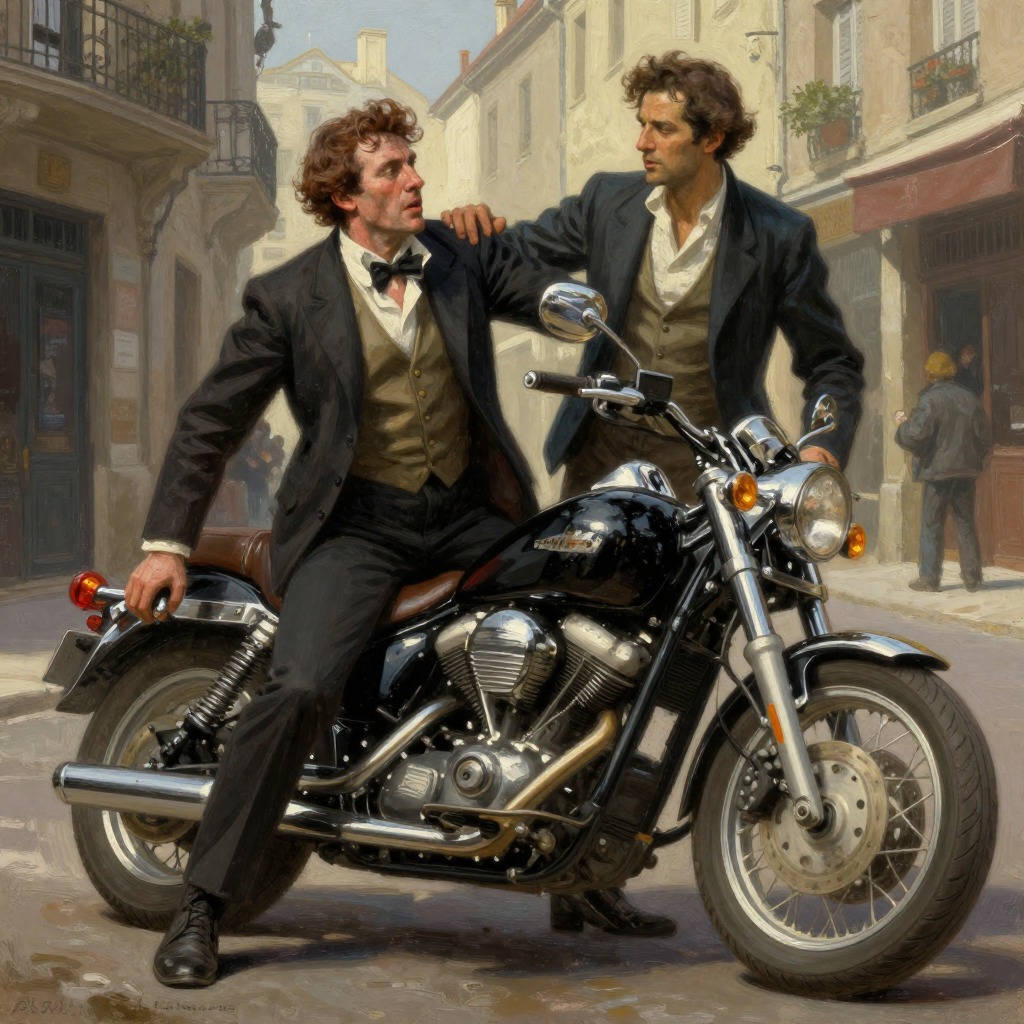
The altercation occurs when Clamence, driving his car, is slow to move at a green light. A small man on a motorcycle, wearing spectacles and plus fours, cuts in front of him and stalls his engine. When the light changes, Clamence politely asks the man to move, but the motorcyclist responds with insults, telling him to "go climb a tree" and then to "go straight to hell." As horns sound behind him, Clamence insists more firmly, and the motorcyclist threatens to give him "a thorough dusting off." Filled with a healthy rage, Clamence gets out of his car, intending to thrash the man, believing his own muscles and height give him the advantage. However, before he can act, a second man—whom Clamence calls "d'Artagnan"—steps from the crowd, accusing Clamence of being "the lowest of the low" for trying to strike a man disadvantaged by his motorcycle. As Clamence turns toward this new antagonist, the motorcyclist restarts his engine and delivers a violent blow to Clamence's ear, then rides away. Dazed and confronted by an exasperated concert of horns from the now considerable line of vehicles, Clamence docilely returns to his car and drives off, hearing the motorcyclist's parting insult: "poor dope."
The Aftermath and Psychological Wound
The episode haunts Clamence for days. He cannot forget it, despite having excuses: he was taken by surprise, addressed from both sides, and the horns put the finishing touch to his embarrassment. Yet he feels he has violated the code of honor. He vividly recalls the ironic gaze of the crowd, especially delighted because he was wearing a very elegant blue suit. The "poor dope" strikes him as justified. In his imagination, he repeatedly runs a film of what he should have done: felling d'Artagnan with a good hook to the jaw, pursuing the motorcyclist, overtaking him, jamming his machine against the curb, and giving him the licking he deserved. But it was too late, and for several days he chews a bitter resentment.
The Revelation of Deeper Desires
When Clamence recovers the recollection of this episode, he realizes what it means. His dream of being a complete man—half Cerdan, half de Gaulle—who manages to make himself respected in his person as well as in his profession has not stood up to facts. He had assumed the manner of a man who dominates in all things, particularly displaying his physical skill. But after being struck in public without reacting, it is no longer possible to cherish that fine picture of himself. He discovers that his true desire was not to be the most intelligent or most generous creature on earth, but only to beat anyone he wanted, to be the stronger, in the most elementary way. He recognizes in himself sweet dreams of oppression. The incident teaches him that he was on the side of the guilty, the accused, only in exactly so far as their crime caused him no harm; when he himself was threatened, he became not only a judge in turn but an irascible master who wanted, regardless of all laws, to strike down the offender and get him on his knees. After this, he finds it very hard to continue seriously believing he has a vocation for justice and is the predestined defender of the widow and orphan.